
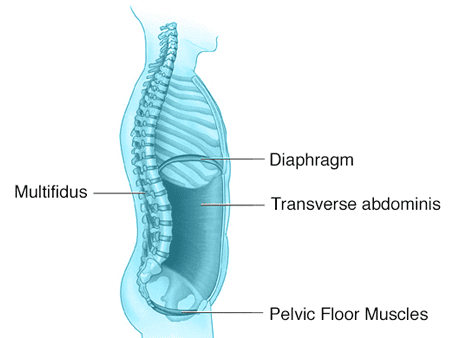
Your deep core is the deepest layer of muscles in the torso and is critical to your health. You can think of it as a canister. There is a top, bottom, front and back.
Top is your diaphragm. It is dome shaped and on the inhale it contracts and floats down towards the abdominal cavity. On the exhale it relaxes and floats up towards your lungs.
Bottom is your pelvic floor. A network of muscles and other connective tissues in the base of the pelvis that provide stability and structure for the pelvis itself and the organs within it.
Back is the spinal muscles. These are the muscles that surround the spine, help maintain good posture, provide stability and mobility.
Front are the abdominal muscles. There are multiple layers of abdominal muscles including the transverse abdominus, rectus abdominus and obliques. All play key roles in the core function.
In order to breathe optimally, you need to engage your entire core, not just your lungs. You need to allow the air to reach down to the bottom of the pelvis and out again. To access your deep core, try this breath
Sit up tall with your rib cage stacked over your pelvis. Alternatively, you can try this lying on your back with your feet on the floor and knees bent. Place your hands on your belly and take a deep inhale all the way down towards your pelvis. Allow your ribs to expand outwards and your diaphragm to expand down into your abdominal cavity. The muscles and connective tissues will lengthen and stretch.
Then on the exhale, try drawing up your entire pelvic floor to get the air out. There is going to be a recoiling action of the pelvic floor muscles and tissues with gained tension as the diaphragm also moves back upwards. This isn’t just stopping the flow of urine, as we are usually advised for kegels. Instead think of closing and lifting all of the openings in your pelvic floor (urethra, vagina, anus).
Take a few breaths like this until it feels more natural. Don’t worry if it feels like you aren’t doing it right at first. We have a tendency to breathe very shallowly into the chest, so it might take some time. Inhale softly into your belly, exhale and lift your pelvic floor. And when you inhale again make sure to relax the pelvic floor! Try not to squeeze your glutes and instead focus on the deep muscles inside the pelvis
This breath is critical to master after giving birth, as it helps stabilize your core and pelvis and can dramatically reduce postpartum recovery time. It is also the base for postpartum exercise; if we want to create a successful response to the demands our body is under during exercise, we need to be able to manipulate how much force and tension we want through the pelvic floor.
For example, the effort on my breathing is extremely relaxed while I’m sitting here writing and I don’t even need to think about it. However, when I’m doing pushups, I need to put more attention into my breathing and develop tension through my core and pelvic floor. On the other hand, too much tension is also not a good thing. Sometimes, trying less to allow breathing to flow with ease is what we want. Matching the tension to the task is key if we want to have a healthy functioning and responsive pelvic floor!
 coachannapetridi